
Lie is the relationship between the long axis (spine) of the fetus and the long axis (spine) of the mother (uterus).
Types of fetal lie
1. Longitudinal lie (most common)
- The fetal spine is parallel to the mother's spine.
- About 99% of pregnancies at term.
Can result in:-
- Cephalic (head-first) presentation
- Breech (buttocks/feet-first) presentation
- This is the lie most suitable for vaginal delivery.
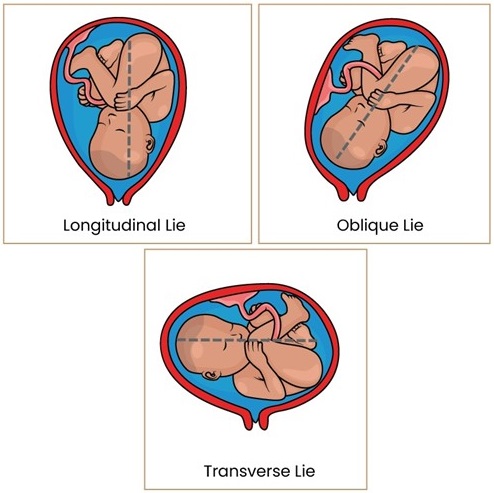
2. Transverse lie
- The fetal spine is at a right angle (90°) to the mother's spine.
- The baby lies across the uterus.
- Usually presents with the shoulder.
- Vaginal delivery is generally not possible unless the lie changes.
3. Oblique lie
- The fetal spine is at an angle between longitudinal and transverse.
- It is often temporary and may change to longitudinal or transverse before labor.
- If it persists during labor, it can cause difficulty with vaginal delivery.
Note-
Lie Relationship of fetal spine to maternal spine
Common presentation
| Longitudinal | Parallel | Cephalic or breech |
| Transverse | Perpendicular (90° | Shoulder |
| Oblique | Diagonal | Variable/unstable |
Presentation-
- Presentation is the part of the fetus that lies over the pelvic inlet or enters the birth canal first during labor.
- Presentation is the part of the fetus that occupies the lower pole of the uterus, lies over the pelvic inlet, and is first to enter the birth canal during labor.
Types of presentation
1. Cephalic presentation (Head presentation) –
Most common (≈95–97%)
The head presents first.
Types of cephalic presentation:-
- Vertex presentation – Head is fully flexed; the occiput presents. (Most common and most favorable for vaginal delivery.)
- Brow presentation – Head is partially extended; the brow (forehead) presents.
- Face presentation – Head is fully extended; the face (mentum/chin) presents.
- Sinciput presentation – Head is incompletely flexed; the bregma (anterior fontanelle) presents.
2. Breech presentation (≈3–4%)-The buttocks or feet present first.
Types of breech:
- Frank breech – Hips flexed, knees extended.
- Complete breech – Hips and knees flexed.
- Footling breech – One or both feet present first.
3. Shoulder presentation
- Usually occurs in a transverse lie.
- The shoulder presents at the pelvic inlet.
- Vaginal delivery is generally not possible unless the lie changes.
Importance of presentation
- Determines the progress and mechanism of labor.
- Helps decide whether vaginal delivery is likely to be safe.
- Abnormal presentations may require special management or cesarean delivery.
Attitude-In obstetrics, attitude refers to the relationship of the different parts of the fetus to one another, especially the position of the head, neck, arms, and legs.
- Attitude is the relationship of the fetal head and limbs to each other (or of the fetal parts to one another).
Normal fetal attitude:
The fetus is in general flexion:
- Head flexed (chin on the chest)
- Arms flexed across the chest
- Thighs flexed onto the abdomen
- Legs flexed at the knees
Abnormal attitudes include:
- Partial extension of the head
- Brow attitude
- Complete extension of the head (face presentation)
Denominator-In obstetrics, the denominator is a fixed bony point on the presenting part of the fetus that is used to describe its position in relation to the mother's pelvis.
- Denominator is the fixed bony landmark on the presenting part of the fetus used to determine and describe the fetal position.

Examples:
- Vertex presentation: Occiput is the denominator.
- Face presentation: Mentum (chin) is the denominator.
- Breech presentation: Sacrum is the denominator.
- Shoulder presentation: Acromion (shoulder tip) is the denominator.
- Brow presentation: Frontal bone (frontum/sinciput) is the denominator.