
Labour- is a physiological process during which products of conception are expelled outside the uterus.
- “Labour that starts spontaneously, is low-risk at the start and remains so throughout labour and delivery. The infant is born spontaneously in the vertex position between 37 and 42 completed weeks of pregnancy. After birth, mother and infant are in good condition.”(According to WHO)
- “The process by which regular uterine contractions bring about progressive cervical dilatation and effacement, resulting in the birth of the baby, placenta, and membranes.”
- Key Features of Normal Labour
- Spontaneous onset of labour
- Low-risk pregnancy throughout labour
- Singleton fetus
- Vertex (head-first) presentation
- Gestational age- 37–42 weeks
- Vaginal spontaneous delivery
- Mother and baby healthy after birth
- Premature (Preterm) Labour-Labour that occurs before 37 completed weeks of pregnancy is called premature or preterm labour.
- Post-term Labour-Labour that occurs after 42 completed weeks of pregnancy is called post-term labour.
Cause of Onset of Labour-
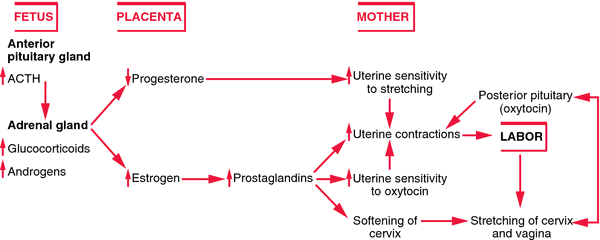
No one knows exactly what triggers the onset of labor. Some researchers think that hormonal changes within the fetus cause the placenta to produce increased levels of a substance known as corticotrophin-releasing hormone.
1. Hormonal Theory
Hormonal imbalance between estrogen and progesterone is considered one of the most important causes.
a) Increased Estrogen-Near term, estrogen level rises.
Actions of Estrogen
- Increases uterine muscle excitability
- Increases sensitivity to oxytocin
- Promotes prostaglandin formation
- Enhances gap junction formation between uterine muscle fibers
Result:
- Coordinated uterine contractions begin
- ↑Estrogen→↑Uterine Excitability
b) Progesterone Withdrawal-Progesterone maintains uterine relaxation during pregnancy.
- Functional progesterone activity decreases
- Uterus becomes irritable and contractile
Effects
- Increased uterine tone
- Increased contractions
- ↓Progesterone Effect→↑Uterine Contractions
2.Oxytocin Theory-Oxytocin is secreted from the posterior pituitary gland.
Role of Oxytocin
- Stimulates rhythmic uterine contractions
- More effective near term because oxytocin receptors increase greatly in the myometrium
Ferguson Reflex-Pressure of fetal head on cervix:
- Cervical stretching occurs
- Nerve impulses travel to hypothalamus
- Posterior pituitary releases oxytocin
- Stronger uterine contractions occur
- Cervical Stretch→Oxytocin Release→Strong Uterine Contractions
3. Prostaglandin Theory
Prostaglandins are produced by:
- Decidua
- Fetal membranes
- Placenta
Important prostaglandins:
- PGE₂
- PGF₂α
Functions-On cervix
- Cervical ripening
- Softening
- Effacement
- Dilatation
On uterus
- Increase strength of contractions
- Increase uterine tone
Prostaglandins→Cervical Ripening + Uterine Contractions
4. Fetal Endocrine Theory-The fetus plays an important role in initiating labour.
Mechanism
Near term:
- Fetal hypothalamus matures
- Fetal pituitary secretes ACTH
- Fetal adrenal gland secretes cortisol
Effects of Fetal Cortisol
- Increases estrogen production
- Decreases progesterone effect
- Stimulates prostaglandin synthesis
Result:
- Labour begins
Fetal Cortisol→↑Estrogen+↑Prostaglandins
5. Uterine Stretch Theory
As pregnancy advances-
- Uterine muscle fibers become overstretched
- Stretching increases myometrial irritability
Seen in
- Multiple pregnancy
- Polyhydramnios
- Large baby
Result
- Contractions are initiated
6. Placental Aging Theory
- Placenta undergoes degeneration and aging
- Placental blood supply decreases
Effects
- Reduced progesterone production
- Increased uterine sensitivity
- Labour starts
7. Mechanical Theory-Mechanical pressure from descending fetal head stimulates labour.
Mechanism
- Head presses on cervix and lower uterine segment
- Cervical stretching stimulates reflex contractions
- This mechanism helps maintain labour once it begins.
8. Gap Junction Theory-Number of gap junctions between uterine muscle cells increases
Importance
- Allows synchronized uterine contractions
- Makes labour effective and coordinated
9. Inflammatory Theory
Labour resembles an inflammatory process.
Changes
- Increased cytokines
- Leukocyte infiltration
- Increased prostaglandins
These changes promote:
- Cervical ripening
- Membrane rupture
- Uterine contractions
10. Neurological factor-
- Estrogen causes α receptors and progesterone β receptors to function
- α receptors of postganglionic nerve fibers in and around cervix, and the lower part of the uterus initiate contraction